
U.S. tariffs are no longer just a trade policy issue. They are becoming an e-commerce issue.
For years, cross-border marketplaces and low-cost online retailers benefited from efficient global supply chains, affordable Chinese manufacturing, and favorable import conditions. This model helped platforms such as Shein and Temu scale quickly in Western markets, especially in the United States.
But the situation is changing.
With higher U.S. tariffs, stricter trade rules, and the end of the de minimis exemption for China and Hong Kong products, the economics of low-cost cross-border e-commerce are under pressure. The impact is not limited to marketplaces. It also affects direct-to-consumer brands, Amazon sellers, pricing strategies, advertising investments, and supply chain decisions.
In simple terms, tariffs are making imported goods more expensive. And when costs go up, e-commerce players have to decide whether to absorb the pressure, increase prices, reduce margins, change suppliers, or rethink their market priorities.
Tariffs Are Challenging the Low-Cost Cross-Border Model
The success of many cross-border e-commerce models has been built on a simple promise: very low prices, large product assortments, and direct shipping from manufacturing hubs to consumers.
This model works best when logistics, duties, and import rules remain favorable.
The latest U.S. tariff environment makes that model more difficult. A 10 percent baseline tariff was introduced on most goods imported into the United States, while trade tensions between the U.S. and China have created even higher tariff pressure on Chinese goods entering the American market.
Another major change is the end of the de minimis exemption for China and Hong Kong products. Previously, this exemption allowed many low-value packages to enter the U.S. duty-free. This was especially important for marketplaces built around small, low-cost shipments.
For companies such as Shein and Temu, this matters because price is a central part of their value proposition. If import costs increase, their ability to offer extremely cheap products becomes weaker.
The result is simple: cross-border e-commerce becomes less frictionless, less cheap, and more exposed to policy changes.
Shein and Temu Are Losing Momentum in the U.S.
One of the clearest signs of disruption is the decline in U.S. mobile users for Shein and Temu.
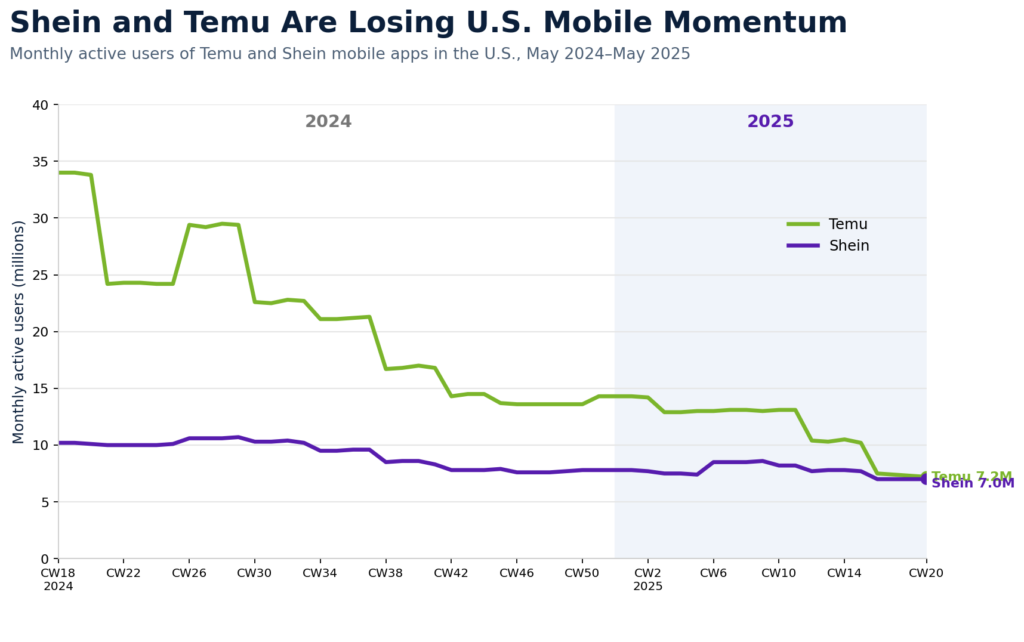
Monthly active users of Temu and Shein mobile apps in the U.S., May 2024–May 2025. Source: Statista / AppMagic.
According to Statista data, both Shein and Temu had fallen below eight million monthly active users in the U.S. by May 2025.
This does not mean that tariffs are the only reason behind the decline. Consumer behavior, competition, media coverage, brand fatigue, and app engagement can all play a role.
However, the trend is important.
It suggests that the low-cost marketplace model is becoming more vulnerable in the U.S. market. If prices rise, delivery conditions change, or consumers perceive less value, engagement can decline quickly.
Temu is particularly interesting because its growth was heavily supported by aggressive advertising and very low prices. If the tariff environment makes this model more expensive, the platform may need to rethink how much it invests in customer acquisition and where it allocates media budget.
This is where tariffs become relevant for retail media and performance marketing teams. Higher import costs can affect pricing, pricing can affect conversion rate, and lower conversion rate can affect advertising efficiency.
In other words, trade policy can end up influencing paid media performance.
Amazon Could Benefit, But It Is Also Exposed
At first glance, Amazon may look like a natural winner.
If Shein and Temu become less competitive in the U.S., some shoppers may shift back to Amazon. This is especially relevant because Amazon has already launched Amazon Haul, a low-price section designed to compete more directly with platforms such as Temu and Shein.
Statista data shows that, as of February 2025, 28 percent of U.S. online shoppers used Temu at least once a month, 23 percent used Shein, and 16 percent used Amazon Haul.
This suggests that Amazon is already participating in the same low-cost shopping battlefield.
However, the story is not that simple.
Amazon is also exposed to the same supply chain pressure. In 2023, 28 percent of Amazon’s gross merchandise value was generated by China-based sellers. Even many non-China-based sellers rely on Chinese manufacturing, sourcing, or components.
So while Amazon may capture part of the demand if Temu and Shein lose momentum, it is not immune from the broader impact of tariffs.
For Amazon sellers, higher import costs can create several problems:
- lower margins;
- higher retail prices;
- weaker conversion rates;
- less flexibility on promotions;
- more pressure on advertising efficiency.
This means that tariffs may not only change which marketplace wins. They may also change how sellers operate inside those marketplaces.
D2C Brands Are Facing a Pricing and Margin Shock
The pressure is not limited to large marketplaces.
Direct-to-consumer brands are also being forced to rethink their business model. Many D2C brands have less ability to absorb higher import costs because they already operate with tight margins, high customer acquisition costs, and direct responsibility for pricing, logistics, and inventory.
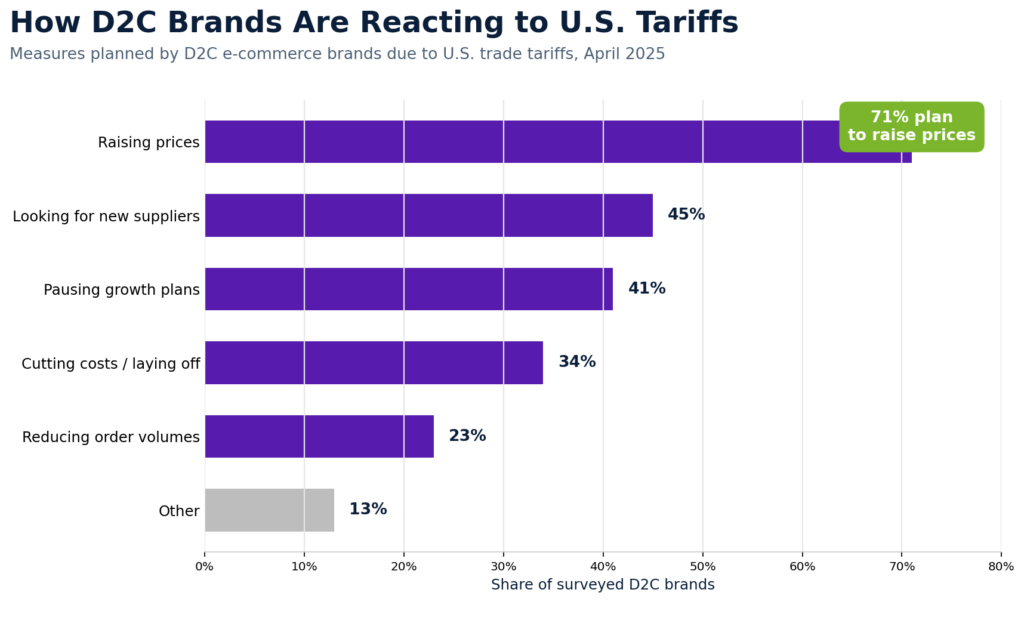
Measures planned by D2C e-commerce brands in response to U.S. trade tariffs, April 2025. Source: Statista / DTC Newsletter.
According to Statista data, 71 percent of D2C e-commerce brands planned to raise prices due to U.S. trade tariffs as of April 2025. Other planned measures included looking for new suppliers, pausing growth plans, cutting costs, laying off staff, and reducing order volumes.
This is a clear signal.
Tariffs are not just increasing landed costs. They are forcing brands to make strategic decisions.
Raising prices may protect margins, but it can also reduce demand. Looking for new suppliers may reduce dependency on China, but it takes time and creates operational complexity. Pausing growth plans may protect short-term cash flow, but it can slow down long-term expansion.
For e-commerce teams, this creates a difficult balance.
They need to protect profitability while still remaining competitive. They also need to decide whether to keep investing in growth channels such as paid search, social commerce, retail media, and marketplace advertising.
If margins become tighter, media budgets may come under pressure. This could make brands more selective about where they invest and more focused on measurable performance.
Europe Could Become More Attractive for Chinese Marketplaces
As the U.S. becomes more challenging, Europe may become more attractive for Chinese marketplaces and cross-border players.
This does not mean that Europe is an easy market. European consumers, regulations, logistics, languages, and marketplace dynamics are complex. However, if the U.S. becomes less profitable or less predictable, Chinese platforms may look for growth in other regions.
The Statista report highlights that Temu reduced its investment in paid traffic on U.S. Google Shopping and increased ad spend in selected European markets. In April 2025, Temu’s estimated ad spend grew by 20 percent year over year in the UK and 115 percent year over year in France.
This suggests a possible reallocation of attention and media investment.
At the same time, European platforms are also strengthening their position. Zalando reached 52.4 million active customers in Europe in Q1 2025, supported by marketplace growth and new integrations such as TikTok Shop.
This creates an interesting competitive scenario.
Europe could become a more important battleground between:
- Chinese low-cost marketplaces;
- established European platforms;
- Amazon;
- social commerce players;
- local retailers and retail media networks.
For brands, this means that marketplace strategy cannot be limited to one platform or one region. The competitive landscape is becoming more fragmented, and geographic priorities may change quickly.
What This Means for E-Commerce and Retail Media Teams
The impact of tariffs goes beyond sourcing and customs.
For e-commerce and retail media teams, tariffs can influence several operational areas.
First, pricing becomes more sensitive. If brands increase prices to protect margins, they need to monitor how conversion rates respond. A small price increase can have a significant impact in highly competitive categories.
Second, advertising efficiency may change. Higher prices can reduce conversion rates, which can increase cost per acquisition and reduce return on ad spend. This is especially important for marketplace advertising, where bidding, conversion rate, and retail price are closely connected.
Third, supply chain decisions become part of media planning. If a brand has inventory constraints, higher landed costs, or supplier uncertainty, media teams need to avoid pushing demand that the business cannot profitably fulfill.
Fourth, marketplace diversification becomes more important. Brands may need to evaluate where demand is growing, where competition is increasing, and where margins remain sustainable.
Finally, teams need to monitor competitors more closely. If Shein, Temu, Amazon Haul, or other low-cost players change pricing, promotion, or advertising intensity, the impact can be visible across categories.
In this environment, e-commerce teams should track:
- pricing changes;
- conversion rate trends;
- paid search competitiveness;
- share of voice;
- marketplace traffic;
- inventory availability;
- supplier dependency;
- margin after advertising spend.
Tariffs may look like a supply chain topic, but they can quickly become a performance marketing topic.
Final Thoughts
U.S. tariffs are reshaping the economics of cross-border e-commerce.
The impact is visible across different levels of the market. Shein and Temu are losing mobile momentum in the U.S. Amazon may benefit from this disruption, but it is also exposed to Chinese supply chains. D2C brands are preparing price increases, supplier changes, and cost reductions. Europe may become a more attractive growth area for Chinese marketplaces.
The key point is simple: tariffs do not only increase costs. They change competitive dynamics.
For e-commerce, marketplace, and retail media teams, this means that trade policy can no longer be treated as a distant macroeconomic topic. It can influence pricing, conversion rates, media efficiency, supply chain resilience, and international growth priorities.
Cross-border e-commerce is not disappearing. But it is becoming more complex, more expensive, and more strategic.
FAQ
Tariffs are duties or taxes applied to imported goods. In e-commerce, they can increase the landed cost of products sold across borders, especially when goods are imported from countries affected by higher trade duties.
Shein and Temu rely heavily on low-cost cross-border commerce and Chinese supply chains. Higher tariffs can increase import costs and reduce the price advantage that helped these platforms grow quickly.
Amazon could benefit if shoppers move away from Shein and Temu. However, Amazon is also exposed because many sellers on its marketplace are based in China or depend on Chinese manufacturing.
Tariffs can increase product costs for D2C brands. As a result, many brands may raise prices, look for new suppliers, reduce order volumes, cut costs, or pause growth plans.
If the U.S. becomes more expensive or less predictable, Chinese marketplaces may increase their focus on Europe. Some data already suggests stronger ad spend growth for Temu in selected European markets such as the UK and France.

Retail Media & Commerce Growth Leader with 8+ years across Amazon and leading marketplaces. I design full-funnel strategy, governance, and measurement—building operating models and developing teams to scale performance across markets. I share practical frameworks and tools for sustainable growth.